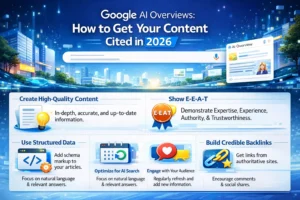
E-E-A-T for Google AI Overviews is not the same as E-E-A-T for traditional SEO and understanding that difference is what separates sites that get cited from sites that get ignored. Research analyzing thousands of AI Overview results found that 96% of cited content comes from sources with verified E-E-A-T signals. In 2026, E-E-A-T has shifted from a content quality guideline into an active AI filtering mechanism. Content without these signals gets removed from consideration before anything else is evaluated. Here is what each signal means in practice and what to add to your site today.
What E-E-A-T Actually Means in 2026
Understanding E-E-A-T for Google AI Overviews starts with understanding what the term actually covers. E-E-A-T stands for Experience, Expertise, Authoritativeness, and Trustworthiness. Google’s Search Quality Rater Guidelines define it as the framework human quality raters use to evaluate content and those evaluations train the ranking algorithms.
The E-E-A-T signals 2026 requires are more demanding than previous years. Google’s December 2025 Core Update expanded the scope significantly, meaning E-E-A-T content guidelines now apply to virtually all competitive searches not just health and finance topics as they originally did.
It is not a direct ranking factor, there is no “E-E-A-T score” in the algorithm. What it describes are qualities content must demonstrate to earn trust from both humans and AI systems. Content that lacks these qualities consistently underperforms, regardless of keyword optimization or backlink counts.
In 2025, something important shifted. Research from BlissDrive found that Google’s December 2025 Core Update expanded E-E-A-T requirements beyond traditional health and finance topics to cover virtually all competitive searches including SEO guides, how-to content, and digital marketing tutorials. That covers everything Technexies publishes.

Part of a Series
This article is part of our AI Overviews cluster. For the full strategy — content structure, schema, and tracking read the main guide: How to Appear in Google AI Overviews: A Complete 2026 Guide.
Experience – Show You Have Actually Done This
Experience is the newest addition to the E-E-A-T framework, added by Google in late 2022. It distinguishes between people who have researched a topic and people who have actually lived it and Google increasingly weights first-hand experience as a citation signal.
AI systems are good at generating expert-sounding content from research. What they cannot replicate is genuine first-hand experience. That is exactly why Google values it, it is the hardest thing to fake.
What Experience Signals Look Like in Practice
- Screenshots of real results from your own work, not stock images or generic examples
- Specific numbers and dates from actual projects: “When I fixed the canonical errors on a client site in January 2026, Google re-crawled and indexed 340 pages within 11 days”
- Honest assessments of what did not work, not just what did real experience includes failures
- Tool screenshots showing actual data, not mock-ups
- Mentions of real tools, platforms, and workflows you personally use
For Technexies specifically: Kia Selmonton has over 10 years of direct SEO experience. That experience should appear in the content itself not just in the author bio. When you reference a specific technique, mention when you used it, on what type of site, and what happened.
Expertise – Make Your Credentials Visible and Machine-Readable
Expertise means demonstrable knowledge in your subject area. For AI systems to recognize it, your author credentials SEO setup needs to be visible in two places: inside the content itself and in the technical markup of your author pages.
Author Bylines on Every Article
Every single article on Technexies must show the author’s name, and that name must link to a full author bio page. The bio page should clearly state relevant experience, specific areas of expertise, and include links to external profiles like LinkedIn.
Person Schema on the Author Bio Page
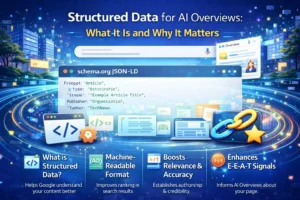
Research from ClickRank emphasizes that author profiles need to be “machine-verifiable, not just visible to humans.” Add Person schema to your author bio page that includes the author’s name, job title, URL, and a sameAs property linking to LinkedIn or other external profiles. This allows Google’s Knowledge Graph to verify the author entity exists beyond just your own website.
{
  "@context": "https://schema.org",
  "@type": "Person",
  "name": "Kia Selmonton",
  "jobTitle": "SEO Expert and Founder",
  "url": "https://technexies.com/about-us/",
  "knowsAbout": ["SEO", "Technical SEO", "Digital Marketing",
                  "Google Algorithm Updates", "AI Overviews"],
  "sameAs": [
    "https://www.linkedin.com/in/kia-selmonton",
    "https://twitter.com/technexies"
  ]
}
Authoritativeness – Get Recognized Beyond Your Own Site
Authoritativeness is about external recognition. It comes from other credible sources citing you, linking to you, or mentioning you as a reference. This is the hardest E-E-A-T signal to build quickly and the most valuable long-term.
Research from Stackmatix found that adding expert quotations to content increases AI Overview visibility by 37%, and that linking to trusted authoritative sources within your content increases AI visibility by 132%. Both of these are things you can control in your own writing today.
How to Build Authority as a New Publication
Respond to questions in r/SEO, r/blogging, and relevant Twitter/X discussions as Kia Selmonton from Technexies. Each mention where your name and site appear together online strengthens your entity association in Google’s Knowledge Graph.
Even small original data studies is a survey of 50 site owners, an analysis of your own traffic data are highly citeable. Princeton’s GEO research found content with specific original statistics improved AI citation rates by 30 to 40%.
SEO newsletters like Search Engine Roundtable, Search Engine Land, and niche marketing newsletters regularly include expert quotes. A single mention in a respected publication generates backlink authority and entity recognition simultaneously.
Trustworthiness – The Most Important Signal
Google’s own quality rater guidelines explicitly state that Trustworthiness is the center of E-E-A-T. The trustworthiness signals Google AI systems look for go beyond just having a secure website or a privacy policy. They include content accuracy, source citations, author transparency, and consistent factual reliability across your entire site.
Trustworthiness is about accuracy, transparency, and reliability. For Technexies, these are the specific trust signals that matter most right now:
Cite Every Data Point to Its Original Source
Every statistic, study result, or factual claim in your articles must link to the original source — not another blog that summarized the study, but the actual study or report itself. Research shows that content with verifiable, cross-referenceable facts has 89% higher probability of AI citation. This is the single fastest trust improvement you can make.
Add Last Updated Dates to Articles
Add a visible “Last Updated” date to every article. When you update an article with new data or correct outdated information, log it. Research from T-Ranks recommends adding a small “Corrections” or “Update History” section to key articles. For example: “Updated March 2026 — Added 2026 citation data from Wellows study.” This demonstrates active content maintenance, which is a direct trust signal.
Keep Your About Page and Contact Page Complete
A site without a detailed about page and accessible contact information signals low trust to both Google and readers. Your about page should name Kia Selmonton clearly, state specific experience and credentials, and link to at least one external profile. Your contact page should have a working form or email address.
E-E-A-T Checklist for Technexies
- Every article shows Kia Selmonton as the named author with a link to the author bio page
- Author bio page includes specific credentials, years of experience, and links to LinkedIn or external profiles
- Person schema added to the author bio page with knowsAbout and sameAs properties
- Every data point in every article links to the original source — not a secondary blog
- Articles include at least one concrete first-hand example — a real result, screenshot, or personal experience
- Last Updated date is visible on every article
- About page clearly identifies the founder, states specific experience, and links externally
- Contact page has a working contact method
- At least one external publication or community has mentioned Kia Selmonton or Technexies
Frequently Asked Questions
Q. Is E-E-A-T a direct Google ranking factor?
No. E-E-A-T is not a direct ranking factor — there is no E-E-A-T score in the algorithm. It is a framework that describes qualities Google’s systems try to detect and reward. Content that demonstrates strong E-E-A-T signals consistently performs better in both traditional rankings and AI citations, but it works indirectly through multiple signals rather than a single metric.
Q. How long does it take to build strong E-E-A-T signals?
Some signals you can add today — author bios, source citations, schema markup, last updated dates. Others take months to build — external mentions, backlinks from authority sites, original research citations. Focus on the immediate signals first and build the longer-term authority signals consistently over time. Most sites see measurable improvement within 90 days of systematic E-E-A-T optimization.
Q. Does E-E-A-T apply to all topics or just health and finance?
It applies to all topics. Google’s December 2025 Core Update expanded E-E-A-T requirements beyond YMYL (Your Money or Your Life) topics to cover virtually all competitive searches. SEO guides, digital marketing tutorials, and how-to content are all now evaluated against E-E-A-T standards.

Kia has worked in SEO and digital marketing for over a decade, building and optimising websites across different industries. He founded Technexies to share what actually works in modern search written from direct professional experience rather than theory. All content on Technexies is researched, written, and reviewed by Kia personally.