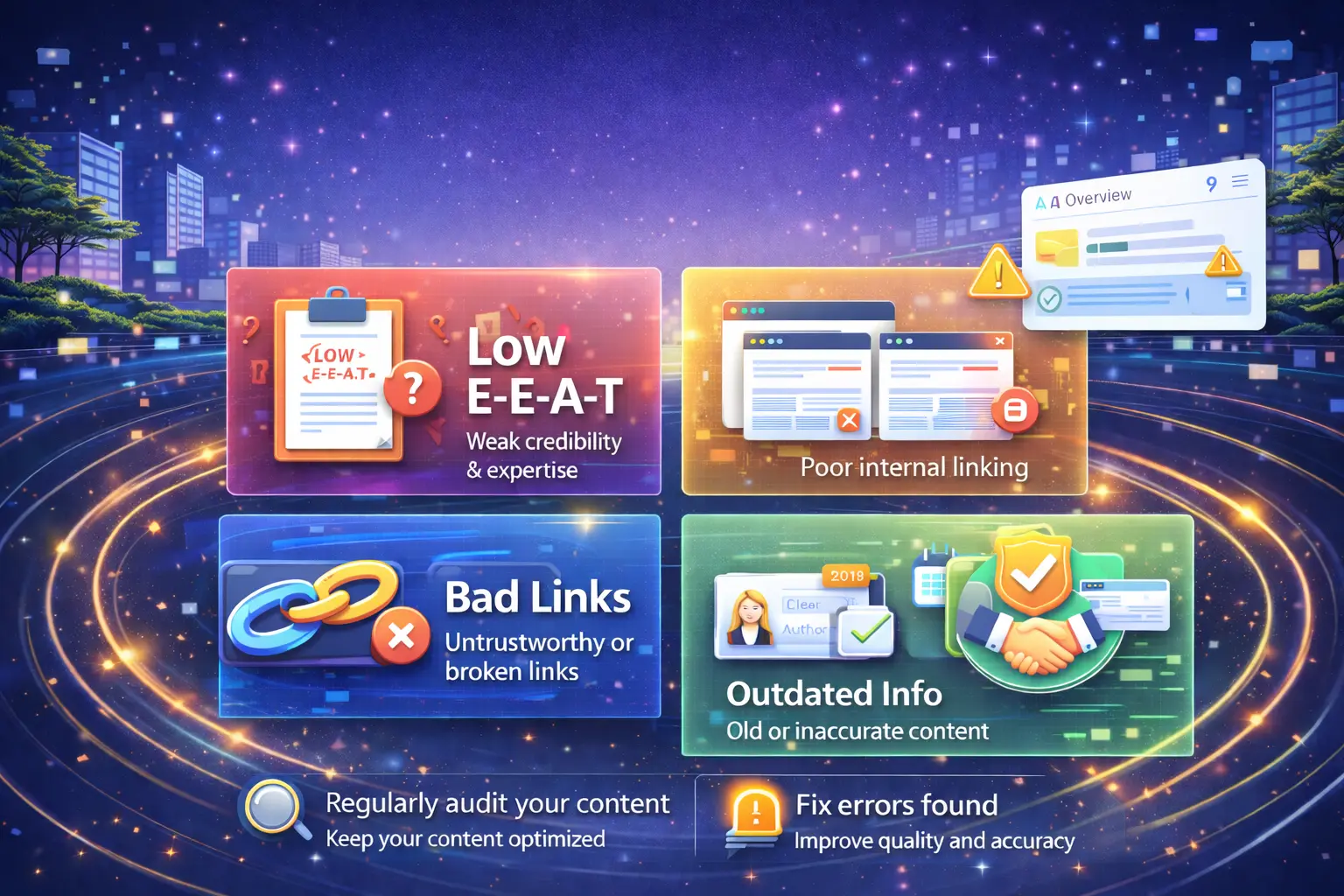
AI Overview optimization mistakes are far more common than most site owners realise and the frustrating part is that they are almost always fixable. You have published solid content, you rank for your target keywords, and yet Google AI Overviews keep citing your competitors instead of you. There are six specific reasons why AI systems skip content, and each one has a clear, actionable solution. Here they are, in the order that matters most.
Reason 1 – Your Answers Are Not Self-Contained
The most common reason why content is not cited in AI Overviews comes down to one thing: answers that require context from elsewhere on the page to make sense. Google’s AI needs to extract a clean, complete answer from your page on its own. If the answer to a question is split across multiple paragraphs, relies on context from earlier in the article, or requires the reader to scroll elsewhere to understand it, the AI moves to a page that makes extraction easier.
Research analyzing 15,847 AI Overview results found that pages scoring above 8.5 out of 10 for semantic completeness are 4.2 times more likely to be cited. The AI actively prioritises passages that fully answer queries in 134 to 167 word self-contained units.
The Fix
Go through your existing articles and find every H2 and H3 section. Ask yourself, if someone read only this section heading and the text immediately below it, would they get a complete, useful answer? If not, rewrite the section so it stands on its own. Lead with the direct answer in the first sentence. Then explain, qualify, or give examples in the sentences that follow.
“As we covered in the previous section, canonical tags work alongside your sitemap to help Google understand your site structure. They are particularly important when you have duplicate pages, which we will explore next.”
“A canonical tag tells Google which version of a URL is the main one when you have duplicate or near-identical pages. Add it inside the <head> section of your page pointing to the preferred URL. For example: if your article exists at both /seo-guide and /seo-guide?source=newsletter, the canonical tag on both pages should point to /seo-guide.”
Reason 2 – You Have No Schema Markup
Pages without structured data force Google’s AI to guess what the content represents, who wrote it, and what questions it answers. Pages with schema markup provide this information explicitly and AI systems consistently prefer the page that requires the least inference.
Structured data markup shows 73% higher AI Overview selection rates compared to unmarked content. That is a significant lift available to any site willing to spend 30 minutes on implementation.
The Fix
If you use Rank Math, Article schema is already being added automatically to your posts. The missing pieces for most sites are FAQPage schema (add a Rank Math FAQ block to any article with a FAQ section) and Person schema on your author bio page. These two additions alone cover the most impactful schema gaps for an SEO content site like Technexies.
Go Deeper
For a full explanation of which schema types matter most and step-by-step WordPress implementation: How to Appear in Google AI Overviews — Schema Section.
Reason 3 – Your E-E-A-T Signals Are Weak or Invisible
BlissDrive’s 2026 research found that 96% of AI Overview citations come from sources with verified E-E-A-T signals. If you want to improve AI Overview visibility, fixing your E-E-A-T signals is the single highest-leverage change you can make because it affects every page on your site simultaneously.
The AI Overview Content Fix for E-E-A-T
Check these four things right now on your most important articles:
- Is there a named author byline that links to a bio page?
- Does the bio page clearly state specific experience and link to external profiles?
- Does every data point in the article link to its original source?
- Is there a visible publish date and last updated date?
If any of these are missing, fix them before working on anything else. They affect your entire site’s citation potential, not just individual articles.
Reason 4 – Your Content Is Text-Only
This one surprises a lot of people. Research from Wellows identified multi-modal content as the biggest single ranking shift in 2025 for AI Overviews. Pages combining text, images, videos, and structured data see 156% higher selection rates compared to text-only pages. Full multi-modal integration with schema delivers up to 317% more citations.
The Fix
The image should be directly related to the section it appears in not a generic stock photo placed randomly. Give it a descriptive alt text that matches the surrounding content. Add ImageObject schema if possible.
Do not just drop an image in and move on. Write a sentence that references it: “The screenshot below shows what a correctly configured canonical tag looks like in a site’s source code.” This creates semantic connection between text and image that AI systems can read.
YouTube videos embedded in articles with optimised titles, descriptions, and timestamps are increasingly integrated into AI Overviews. A screen-recorded walkthrough of a technical process takes 20 minutes to create and significantly increases your multi-modal signals.
Reason 5 – Your Facts Cannot Be Verified
If Google AI is not citing your content despite good structure and schema, unverifiable facts may be the reason. Google’s AI cross-references your content’s claims against authoritative databases before deciding whether to cite you. If your article makes factual claims without linking to verifiable sources, it fails this check and the AI moves to content it can confirm independently.
Research shows that content with verifiable, recently updated facts and authoritative citations has 89% higher AI Overview selection probability. Linking to trusted external sources is not just good academic practice it is an active citation signal.
The Fix
Do an audit of your existing pillar articles. For every statistic or study result cited, check whether it links to the original source. If it links to another blog that mentioned the study find the original study and update the link. If it has no link at all, either find a source or remove the claim. Unsourced statistics are worse than no statistics at all for AI citation purposes.
Reason 6 – Your Topic Coverage Is Too Shallow
AI Overviews do not just look for pages that answer the main query. They fan out to dozens of related sub-queries and pull the best content for each one. A 500-word article that covers only the surface of a topic will be ignored in favour of a 2,000-word guide that covers the main topic and five related questions in depth.
This is why publishing a cluster of articles around a pillar topic rather than one standalone article is so effective for AI visibility. Wellows’ study identified topical depth as the sixth most important factor for AI citations: sites that cover a topic comprehensively earn more citations across the entire cluster.
The Fix
Search your target topic in Google and spend 10 minutes noting every “People Also Ask” question that appears. These are exactly the sub-questions Google’s AI fans out to when building an Overview. If your current article does not address most of them, add them as H3 sections with complete, self-contained answers. Or publish them as individual cluster articles which is exactly what Technexies is doing with this article series.
Which Fix to Tackle First
These AI Overview optimization mistakes do not all carry equal weight. If all six issues apply to your content, fix them in this priority order for the fastest improvement:
| Priority | Fix | Time Required | Impact |
|---|---|---|---|
| 1 | Add named author byline and bio page with external links | 30 min | Very High — affects entire site |
| 2 | Link every data point to its original source | 1 to 2 hours per article | Very High — direct verification signal |
| 3 | Add FAQPage schema to existing articles | 20 min per article | High — 73% higher selection rate |
| 4 | Rewrite key sections as self-contained answer blocks | 1 hour per article | High — addresses the most common reason for exclusion |
| 5 | Add relevant images with descriptive alt text | 30 min per article | Medium-High — 156% lift with full multi-modal |
| 6 | Expand shallow articles with People Also Ask sections | 2 to 3 hours per article | Medium — topical depth builds cluster authority over time |
Frequently Asked Questions
Q. How quickly can I expect to see results after fixing these issues?
Adding statistics with authoritative citations and restructuring content into clear answer blocks can show results in 30 to 45 days for indexed pages. E-E-A-T signals and topical authority take longer most sites see measurable AI citation improvements within 90 days of systematic optimization. Schema changes take effect within a few days of Google re-crawling the updated pages.
Q. Does ranking in the top 10 guarantee AI Overview citation?
No. Only 4.5% of AI Overview URLs directly match the top organic position, according to Stackmatix research. Ranking well helps there is an 86% domain overlap between AI Overview sources and organic top results but high ranking alone does not guarantee citation. Content quality, schema, and E-E-A-T signals are evaluated separately from ranking position.
Q. Can I opt out of appearing in Google AI Overviews?
Not directly from within your own site settings. As of early 2026, the UK’s Competition and Markets Authority is reviewing proposals to let publishers opt out, but no official opt-out mechanism exists yet. If you want to prevent Google from using your content in AI features, you would need to use noindex directives, which would also remove you from traditional search results entirely.

Kia has worked in SEO and digital marketing for over a decade, building and optimising websites across different industries. He founded Technexies to share what actually works in modern search written from direct professional experience rather than theory. All content on Technexies is researched, written, and reviewed by Kia personally.