If you are trying to figure out how to appear in Google AI Overviews, you are asking the right question. These AI-generated summaries now show up on roughly 25% of all Google searches globally and the sites cited inside them earn 35% more organic clicks than those that are not. This guide breaks down exactly how AI Overviews work, what Google’s AI looks for when choosing sources, and the specific steps you can take to start getting cited.
What Are Google AI Overviews?
Google AI Overviews are AI-generated summaries that appear at the very top of search results above the traditional ten blue links. Google launched them globally in 2024 and powered them with its Gemini AI model.
Instead of pulling a single excerpt from one page (like a featured snippet), AI Overviews synthesize information from multiple sources and display a written answer with links to the pages it drew from. Those links the citations at the bottom of the AI answer are what every website owner should be aiming for.
Think of it like a Wikipedia summary at the top of Google. Except instead of one editor deciding what goes in, an AI model reads dozens of pages, picks the best-structured and most trustworthy information, and builds its own answer. The sites it quotes become the cited sources.
AI Overviews are not replacing Google search. They are adding a new layer on top of it. Traditional rankings still matter but being cited inside the AI answer is now a separate and increasingly valuable ranking opportunity on its own.
AI Overviews vs. Featured Snippets – What is the Difference?
People often confuse AI Overviews with featured snippets. They are not the same thing.
| Feature | Featured Snippet | AI Overview |
|---|---|---|
| Source count | One page | Multiple pages (typically 6 to 14) |
| Content type | Direct excerpt | AI-synthesized summary |
| Position | Usually position 1 | Above all organic results |
| Ranking required? | Almost always yes | Not necessarily — pages outside top 10 get cited |
| Primary triggers | How, what, why questions | Informational, complex, multi-part queries |
That last row is important. You do not need to rank in the top 10 to be cited in an AI Overview. This levels the playing field for newer or smaller sites in a way that traditional SEO never did.
Why AI Overviews Matter for Your Site
Here is the honest picture. AI Overviews are both a threat and an opportunity, depending entirely on what you do next.
The story those numbers tell is straightforward. If an AI Overview appears for a query you rank for, and your page is not cited inside it, your traffic will drop. Semrush’s 2025 study of 10 million keywords found that AI Overview visibility peaked at nearly 25% of queries in July 2025 before settling around 16% through the end of the year.
But here is the flip side. Seer Interactive’s research found that brands cited in AI Overviews earn 35% more organic clicks and 91% more paid clicks than competitors not cited. Getting inside the overview is not just about visibility it is about being the trusted source Google’s AI has already pre-validated for the user.
That trust signal compounds over time. A user who sees your site cited in an AI answer is far more likely to click your link in the traditional results below it too.
If you publish mostly informational content – how-to guides, explainers, tutorials, AI Overviews will affect you directly. Research from DemandSage shows that 99.2% of the queries that trigger AI Overviews have informational intent. That is exactly the content most bloggers, SEO sites, and educational platforms publish.

Who Actually Gets Cited and Why
This is the question everyone wants answered. The good news is that researchers have studied this extensively, and the patterns are clear.
You Do Not Need to Rank First
Here is something that surprised a lot of SEOs when the data first came out. Research published in early 2026 found that the percentage of AI Overview citations coming from top-10 ranking pages dropped from 76% in mid-2025 to roughly 38% by early 2026. That means well over half of cited pages now rank outside the top 10 for the primary query.
The reason is something called fan-out queries. When Google’s Gemini AI builds an AI Overview, it does not just look at the top results for the main search. It fans out to dozens of related sub-queries and pulls the best content for each one. A page that ranks position 40 for a closely related sub-topic can end up cited in an AI Overview for the primary query.
The practical implication: comprehensive content that covers a topic and its surrounding questions deeply even if it does not rank at the top has a real shot at citation.
If your content is being skipped despite following best practices, we cover the six most common AI Overview optimization mistakes and exactly how to fix each one.
The Seven Factors That Drive Citations
A study analyzing 15,847 AI Overview results across 63 industries identified the primary factors that determine whether content gets cited. Here is what the data shows, ranked by impact:
- Semantic completeness — Content that fully answers a query in a self-contained passage. Pages scoring above 8.5 out of 10 for semantic completeness are 4.2 times more likely to be cited.
- Multi-modal content — Pages that combine text, images, videos, and structured data see 156% higher citation rates compared to text-only pages.
- Real-time factual accuracy — Content with verifiable, recently updated facts and linked citations that AI can cross-reference.
- E-E-A-T signals — Clear authorship, expertise demonstrated in the content, and trust signals like author bios and external mentions.
- Schema markup — SE Ranking research found that approximately 65% of pages cited by Google AI Mode include structured data markup.
- Topical depth — Sites that cover a topic cluster comprehensively (pillar page plus supporting articles) earn more citations across that entire cluster.
- Domain authority and backlinks — High-traffic sites earn roughly 3x more AI citations than low-traffic ones, though this is less dominant than the content factors above.
Domain authority is number seven on that list — not number one. Content quality, structure, and semantic completeness are the top factors. A newer site with genuinely well-structured, authoritative content can earn citations that established sites with mediocre content cannot.
How to Structure Your Content for Citation
This is where most guides stop at vague advice like “write helpful content.” Let me be specific about what actually works.
Write in Answer Blocks
Google’s AI reads your content looking for passages that fully answer a question on their own without requiring the reader to scroll elsewhere on the page. These are called “answer blocks” or “answer islands.”
The formula is simple. State the question clearly (ideally as an H2 or H3 heading), then answer it completely in the next 50 to 150 words. Do not split the answer across multiple paragraphs with unrelated information in between. Keep it self-contained.
Here is the difference in practice:
“Canonical tags are an important part of technical SEO. They were introduced by Google in 2009. As we discussed in the previous section on crawling, canonical tags tell Google which version of a page is the primary one. There are many situations where this matters, which we will explore throughout this guide.”
“A canonical tag is an HTML element that tells Google which version of a URL is the main one when you have duplicate or similar pages. You add it inside the <head> section of your page. For example, if your product page exists at both /product and /product?ref=homepage, the canonical tag on both pages should point to /product, the one you want indexed and ranked.”
The second version is self-contained. Someone reading it gets a complete, useful answer without needing any surrounding context. That is exactly what AI wants to cite.
Make Every H2 and H3 a Real Question
Research updated in January 2026 found that question-based searches are now 84% more likely to display an AI Overview than keyword-style searches. When you write your headings as questions “How does canonical tag work?” rather than “Canonical Tags Explained” you align your content structure with the queries that trigger AI Overviews in the first place.
It also makes your article easier to read, which reduces bounce rate, which feeds positive behavioral signals back to Google. Everything connects.
Cover Related Questions in the Same Article
Remember the fan-out query concept from Section 3? The AI does not just look for one answer, it looks for an answer to the main question and several related sub-questions. An article that answers five related questions in depth is five times more likely to be useful across different fan-out queries than an article that answers one question well.
Before you write, spend 10 minutes searching your target topic on Google. Note every “People Also Ask” question that appears. Those are Google showing you exactly which sub-questions users search for. Incorporate the most relevant ones as H3 sections in your article.
Use Short, Clear Paragraphs
AI systems parse content differently to humans. Long blocks of text with complex sentence structures are harder for AI to extract clean citations from. Aim for paragraphs of 2 to 4 sentences. One clear idea per paragraph. If a sentence needs a comma and another clause to make its point, consider breaking it into two sentences instead.
This also improves readability for human visitors, which improves dwell time, which improves your behavioral signals. Again, everything connects.
Lead with the Answer, Then Explain
Most writers build to their point. In academic writing, you present the argument, develop the evidence, and then conclude. For AI Overview optimization and for modern web readers you need to flip this structure. State your answer in the first sentence after the heading, then use the rest of the paragraph to explain, qualify, or give examples.
If someone reads only your first sentence after each heading, they should understand your article’s entire point. That is the test.
Schema Markup That Actually Helps
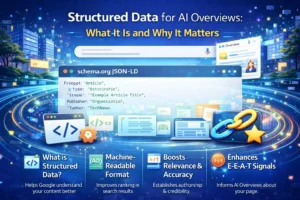
Schema markup is structured data you add to your HTML that tells Google in machine-readable format what your content is about. It does not directly cause AI citations, but it significantly increases the probability of them.
For a complete walkthrough of which schema types matter most and how to add them in WordPress without coding, read our guide on structured data for AI Overviews.
SE Ranking found that 65% of pages cited in Google AI Mode use structured data markup. That is not a coincidence. Schema gives the AI explicit signals about what type of content it is reading, who wrote it, what questions it answers, and how it is organized.
The Four Schema Types That Matter Most
You do not need to implement every schema type ever invented. Focus on these four for maximum impact on AI Overview citations:
Marks your content as an article, identifies the author as a named Person entity, specifies the publish and update dates, and links your publication to an Organization entity. This is the foundation. Every article on Technexies should have this.
Marks up your question-and-answer sections so Google can read each Q&A pair as a structured data object. Pages with FAQ schema are 60% more likely to be cited in AI Overviews compared to pages without it. Add this to every guide that contains a FAQ section, which should be most of your pillar articles.
If your article contains numbered steps, HowTo schema marks each step explicitly so Google’s AI can extract them as structured procedural content. Use this on any tutorial or step-by-step guide you publish.
Tells Google where this article sits within your site structure. It helps establish topical hierarchy, that this article belongs to your SEO cluster, for example — which reinforces your site’s topical authority in that subject area.
How to Add Schema on WordPress
If you use Rank Math (recommended) or Yoast SEO, you can add most of this schema without writing any code. Rank Math adds Article schema automatically to all posts. For FAQPage schema, add a FAQ block in the Gutenberg editor and Rank Math will mark it up automatically.
For HowTo schema, Rank Math has a dedicated HowTo block. Add it, fill in your steps, and the structured data generates automatically.
After adding any schema, validate it using Google’s Rich Results Test. This confirms Google can read your markup without errors. An invalid schema block is worse than no schema at all because it can confuse the AI’s understanding of your content.
{
  "@context": "https://schema.org",
  "@type": "Article",
  "headline": "Google AI Overviews: How to Get Your Content Cited in 2026",
  "author": {
    "@type": "Person",
    "name": "Kia Selmonton",
    "url": "https://technexies.com/about-us/"
  },
  "publisher": {
    "@type": "Organization",
    "name": "Technexies",
    "url": "https://technexies.com"
  },
  "datePublished": "2026-03-04",
  "dateModified": "2026-03-04"
}
Getting your schema and content right is only half the picture. The technical foundation underneath your site matters just as much. Read our complete guide on technical SEO for WordPress to make sure Google can actually crawl and index everything you publish.
Building the E-E-A-T Signals Google Trusts
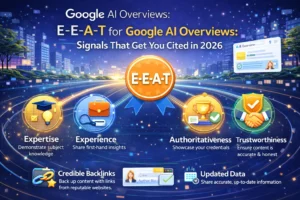
E-E-A-T stands for Experience, Expertise, Authoritativeness, and Trustworthiness. Google’s own quality rater guidelines describe these as the primary lens through which both human quality raters and automated systems evaluate content.
We cover every E-E-A-T signal in detail and exactly what to add to your site today in our dedicated guide: E-E-A-T for Google AI Overviews.
For AI Overviews specifically, research from Relixir found that Google’s AI Mode prioritizes E-E-A-T signals more heavily than traditional search algorithms. In other words, E-E-A-T matters more for AI citation than it does for regular rankings.
Experience – Show You Have Actually Done This
Google distinguishes between people who write about something and people who have done it. First-hand experience signals, screenshots of real results, case studies from your own work, specific examples from real projects tell the AI that this content comes from someone with direct experience, not just research.
For every SEO guide you write on Technexies, include at least one concrete example from actual practice. Not “some websites see improved rankings after fixing canonical errors” but “here is a canonical error I found on a client’s WordPress site, here is what it looked like in Screaming Frog, and here is what changed after fixing it.”
Expertise – Make Your Author Credentials Visible
Every article needs a visible author byline that links to a full author bio page. The author bio page should clearly state the author’s relevant experience, credentials, and background. It should also link to external profiles (LinkedIn, industry publications) so Google can verify the entity exists beyond just this one website.
Rank Math and Yoast both support author schema. Make sure the author on every article is marked up as a named Person entity with a sameAs property linking to external profiles.
Authoritativeness – Get Mentioned Outside Your Own Site
Authority signals that AI systems read include: backlinks from recognized sites, author mentions in other publications, brand mentions across the web, and citations in other articles. You cannot manufacture these overnight, but you can build them deliberately.
Respond to questions in relevant communities (r/SEO, r/blogging, Twitter/X SEO discussions) as your named author identity. Pitch expert quotes to SEO newsletters and publications. Each external mention where your name and your site appear together strengthens the entity association Google needs to trust you as a citeable source.
Trustworthiness – Cite Your Sources
Every data point, statistic, or claim in your articles should link to the original source. This is not just good practice, it is an active trust signal. AI systems are designed to prefer content with verifiable claims that they can cross-reference.
Research from NEURONwriter found that citing authoritative sources increases the probability of AI citation by up to 89%. That is a significant lift for something as simple as adding a link to your source.
How to Track Your AI Overview Presence
One of the frustrating realities of AI Overviews is that Google Search Console does not separate AI Overview impressions and clicks from regular organic search data. As of June 2025, AI clicks count toward your totals under the “Web” search type, but there is no dedicated filter for them.
For a full breakdown of every free and paid method to monitor your citations, read our complete guide on how to check Google AI Overview citations.
That said, you are not flying completely blind. Here are the practical options:
Manual Testing (Free, Always Start Here)
Take your 20 to 30 most important target keywords and search them manually in Google. Note which ones show an AI Overview. Check if your site is cited. Do this once a month and log the results in a simple spreadsheet with columns for: keyword, AI Overview present (yes/no), your site cited (yes/no), which competitor is cited.
This takes about an hour a month and gives you a direct, accurate picture of where you stand.
Google Search Console – Indirect Signal
Filter your Search Console data to show only queries where your pages appear in position 1 to 3. If impressions on those queries are rising but clicks are falling, an AI Overview is likely eating your traffic. This tells you which queries need AI Overview optimization most urgently.
Paid Tools (Worth It at Scale)
Semrush’s AI Toolkit tracks which of your target keywords trigger AI Overviews and monitors which competitors are cited. Tools like Otterly.AI and Profound track your AI citation visibility across Google, ChatGPT, and Perplexity in one dashboard. These are worth considering once your site generates enough traffic to justify the investment.
Quick-Start Checklist for AI Overview Optimization
Work through this list for every pillar article and guide you publish on Technexies. It covers the highest-impact actions from everything in this guide.
- Every H2 and H3 heading is phrased as a question or a clear topic that directly answers a search query
- Each section opens with a direct answer in the first 1 to 2 sentences before explaining further
- No section answer requires the reader to read a different section to understand it each is self-contained
- Article covers the main topic plus at least 5 related questions from Google’s People Also Ask results
- All statistics and data points link to original sources (not other blogs, the actual study or report)
- Article schema is implemented with named author, publish date, and Organization entity
- FAQPage schema added if the article has a FAQ section
- HowTo schema added if the article contains numbered procedural steps
- Author byline is visible, links to the author bio page, and the bio page links to LinkedIn or external profiles
- At least one image with descriptive alt text is included, AI Overviews favour multi-modal content
- Schema validated in Google’s Rich Results Test before publishing
- Article is internally linked from at least 2 other relevant articles on the site
- Article added to sitemap and URL submitted for indexing in Google Search Console
Frequently Asked Questions
Q. What are Google AI Overviews?
Google AI Overviews are AI-generated summaries that appear at the top of Google search results, above all traditional organic results. Powered by Google’s Gemini AI, they synthesize information from multiple websites and display a written answer with links to the cited sources. They currently appear on roughly 25% of all Google searches globally.
Q. Do you need to rank in the top 10 to appear in AI Overviews?
No. Research from early 2026 shows that roughly 62% of pages cited in AI Overviews now rank outside the top 10 organic results for the primary query. Google’s AI fans out to dozens of related sub-queries when building its summary, which means a page ranking position 30 or 40 for a closely related question can still be cited in the main AI Overview.
Q. Does getting cited in an AI Overview increase traffic?
Yes. Research by Seer Interactive found that pages cited in AI Overviews earn 35% more organic clicks and 91% more paid clicks compared to competitor pages not cited. The traffic effect is positive because being cited builds trust users who see your site referenced in an AI answer are more likely to click your traditional result below it too.
Q. What type of content gets cited most often?
Informational content triggers 88 to 99% of all AI Overviews. Content that answers a specific question completely in a short, self-contained passage is significantly more likely to be cited. Question-based headings, FAQ sections with schema markup, and how-to guides with HowTo schema all perform well.
Q. How long does it take to start appearing in AI Overviews?
There is no fixed timeline. Some pages see their first AI Overview citation within days of a content update. For most sites, expect measurable improvement within 4 to 12 weeks of systematic optimization, implementing proper content structure, schema markup, and E-E-A-T signals consistently across multiple articles.
Q. Can small or new websites get cited in AI Overviews?
Yes. Domain authority is the seventh most important factor for AI citations, not the first. Content quality, semantic completeness, and structured data are more important. A new site with genuinely well-structured, authoritative content on a specific niche topic can earn citations that larger, less-focused sites do not. Niche depth beats broad domain authority in the AI citation race.

Kia has worked in SEO and digital marketing for over a decade, building and optimising websites across different industries. He founded Technexies to share what actually works in modern search written from direct professional experience rather than theory. All content on Technexies is researched, written, and reviewed by Kia personally.